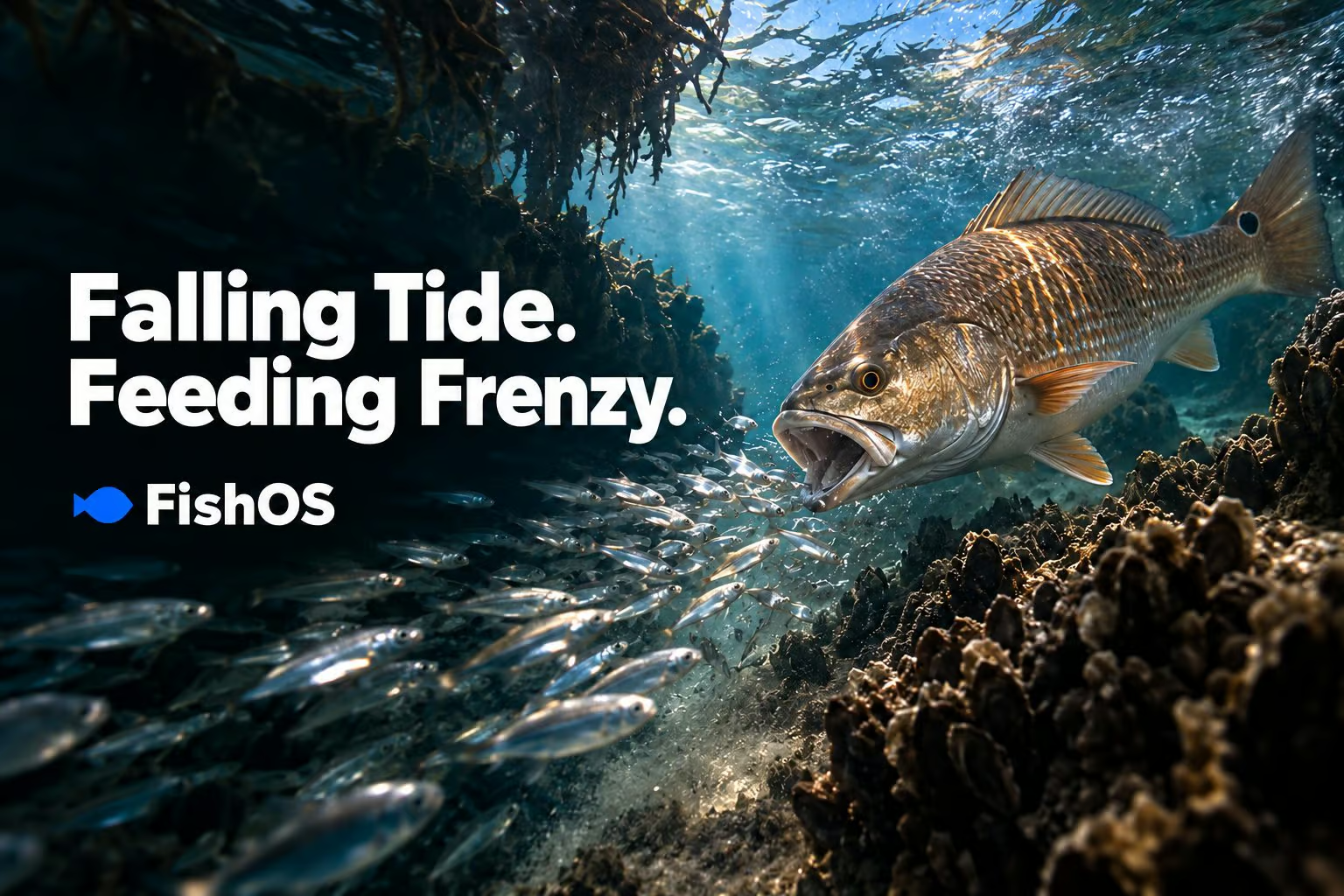
Fishing the falling tide gives anglers a practical way to find food moving through drains, flats, bars, inlets and passes. Start with the local tide table, identify the outgoing current, then choose a presentation that matches the structure and leave a route home before shallow water cuts it off.
How falling tides concentrate food
The source article describes falling water as a delivery system for baitfish, crabs and shrimp. It gives specific field examples at a marsh runout, a creek between a sand flat and an oyster bar, and inlets beside seawalls, rocky banks and jetties. Those accounts are useful because they identify where to look, but they are observations from particular places rather than a guarantee that every falling tide will produce the same result.
NOAA describes an ebb current as water moving away from the coast as low tide approaches. Its tidal charts use a reference datum, and the agency advises checking local charts for coastal activities. NOAA also provides predicted high- and low-water times at more than 3,000 U.S. locations through its Center for Operational Oceanographic Products and Services. A tide prediction gives the timing and height at a stated reference point, but local current strength and how that water moves through a creek, pass or marsh depend on the place you are fishing.
A 1984 study by Tony Pitcher, published in Estuarine, Coastal and Shelf Science, used ultrasonic tracking in an estuary to examine flounder movements in relation to tidal feeding. The research record gives the study title and publication details, but the abstract does not give the sample size or measured outcomes. It is therefore useful as background on the subject, not as evidence for a specific lure, tide height or catch rate.
Check the tide and current first
Begin with the official local tide table, then compare the planned fishing area with the predicted ebb. NOAA explains that most tides are semidiurnal, with two high-water and two low-water points each day, usually alternating at about six-hour intervals. That pattern is not identical at every location. The source article likewise says timing and current strength vary by place.
Consider how the current moves through the chosen area. A narrow marsh runout can funnel forage into a short section of bank. A creek can carry forage along the edge of a sand flat or oyster bar. An inlet can sweep bait from an estuary past seawalls, rocks and jetties. Check local conditions before choosing a route.
Where Fish Were Reported Feeding
| Location | Current clue | Forage reported | Fish and presentation reported | Exit concern |
|---|---|---|---|---|
| Marsh runout | Water drains from a lagoon or pond through a small opening. | Finger mullet and blue crabs. | Paddletails, topwaters, artificial shrimp and subsurface hard baits; soft jerkbaits and popping cork rigs are also options outside the outlet. | Check the return route before the runout becomes too shallow. |
| Sand flat beside an oyster bar | Outgoing creek water passes between a broad flat and a bar. | Baitfish moving through the creek. | Trout rose from current-shielded low spots for jigs and twitchbaits; the source also reports redfish, jacks and a few flounder. | Low spots and bars can become exposed as the tide falls. |
| Inlet or pass | Water moves past seawalls, rocky banks and jetties. | Forage swept from the estuary. | Snook, snapper and grouper were identified as inlet predators; present bait close to fish holding below. | Plan around the inlet’s return route and changing current. |
| Marsh pond and pass network | Seasonal baitfish or shrimp leave with outgoing water. | Baitfish schools and migrating shrimp. | The source identifies tarpon, jacks, bluefish, mackerel, false albacore, sharks, redfish and trout as fish that may feed on the moving forage. | Longer exposed flats and marsh routes need extra margin. |
| Passes and current seams during crab flushes | Strong spring or summer moon tides pull swimming crabs from backwaters. | Reportedly thousands of swimming crabs. | Long-handle dip nets and live bait used around full and new moons. | Keep the planned exit open as the ebb strengthens. |
The marsh, sand-flat, oyster-bar and flounder details come from the source article’s field accounts. They should be treated as location-specific observations. The source does not provide a controlled survey, sample size or measured catch rate for those scenes.
How to work the current
Marsh drains concentrate movement into a defined outlet. In the source account, the author found about a dozen finger mullet at each turn of a small runout and saw blue crabs heading toward the exit. Capt. Ross Montet described the drains as focal points once a high tide starts falling. Paddletails, topwaters, artificial shrimp and subsurface hard baits were listed as producing presentations there.
Vegetation can filter the water as it leaves the marsh. Baitfish may then favor the cleaner water just outside the outlet, where redfish, trout and flounder are possible targets.
Along a creek, the source describes trout rising from low spots shielded from the strongest current to take jigs and twitchbaits. It also reports redfish, jacks and a few flounder in the same falling-water pattern. The account is useful for choosing a target, but the source does not establish that flounder are commonly caught there with that method.
At inlets, bait placement matters. Capt. Ed Zyak said bait about one foot above a fish may be easier to eat than bait positioned 10 to 15 feet overhead. His explanation was that inlet predators can wait near the bottom for forage moving past them. Use that as a presentation cue, not a fixed rule for every fish. Consider the fish and current when choosing bait height.
Seasonal bait movement and crab flushes
Cooler autumn conditions can push baitfish out of bays and estuaries through passes. One captain describes outgoing tides carrying baitfish toward fish including tarpon, jacks, bluefish, mackerel, false albacore and sharks. Marsh shrimp also leave nursery areas during the fall for offshore spawning, with redfish, trout and other predators following the tide-driven movement.
New and full moons were identified as bringing stronger flows. The source also gives a reason not to treat a full moon as a guarantee of daytime action: baitfish may feed through the night under clear lunar conditions, leaving fish with full stomachs when daytime anglers arrive. That is a reported fishing pattern, not a controlled study result.
During strong spring and summer tides, the source describes crab flushes that pull thousands of swimming crabs from backwaters through major passes. Silver forms rolling along current seams can provide a visible sign of concentrated movement. Capt. Grassett said live-bait anglers scoop crabs on the outgoing tide around full and new moons and then fish the passes or beach.
How to plan the exit
The safest plan accounts for the direction of travel, the time needed to leave and the ground that will be exposed as the water drops. The source gives two useful contrasts. Laguna Madre has a tidal swing of a foot or two, while interior parts of the South Atlantic Bight have swings of 6 to 8 feet. Check the local tide table rather than relying on those examples.
Several experienced teams reportedly missed weigh-ins during the 2023 Bassmaster Redfish Cup Championship after becoming stuck on mud flats. That is a warning about tidal stranding, not proof that every mud flat is dangerous at the same time. Ask for the local tide and current information before launching, identify an alternate route if the main route crosses a flat, creek or marsh, and note mud that may become difficult to cross.
NOAA advises checking local tidal charts for safe planning. Plan the outing’s communication, navigation and flotation equipment, and monitor water levels without assuming that the predicted low-water time is the time the route becomes usable.
What to do now
- Check the official local tide table and current before selecting a marsh drain, sand flat, oyster bar, inlet or pass. Record the expected ebb and the planned return time.
- Choose one feature based on the current clue. Work a marsh runout for forage moving through the outlet, a sand flat beside an oyster bar for a creek seam, or an inlet beside a seawall, rock bank or jetty.
- Match the presentation to the structure. The source lists paddletails, topwaters, artificial shrimp, subsurface hard baits, soft jerkbaits and popping cork rigs around marsh drains. For the creek account, it names jigs and twitchbaits.
- Keep the bait accessible. Capt. Ed Zyak said bait about one foot above a fish may be easier to eat than bait 10 to 15 feet overhead. Treat this as a starting point and adjust to the fish and current.
- Set a return plan before the first cast. Identify the primary and alternate exits, note mud or marsh hazards, monitor the water level and leave enough time to reach safety. The 2023 Redfish Cup account described experienced anglers becoming stuck on mud flats during a falling tide.
FAQ
Why can fishing the falling tide work?
Outgoing water can carry baitfish, crabs and shrimp through drains, along structural edges and past bars or passes, giving fish feeding opportunities near structure. The strength and direction of the current depend on the location.
What presentations are described around falling-tide structure?
The source names paddletails, topwaters, artificial shrimp, subsurface hard baits, soft jerkbaits and popping cork rigs around marsh drains, plus jigs, twitchbaits and a MirrOlure around a creek current seam.
What should anglers check before leaving on a falling tide?
Check the local tide table and current, identify alternate exit routes, note mud and marsh hazards, monitor changing water levels and carry the flotation, communication and navigation equipment required for the outing.