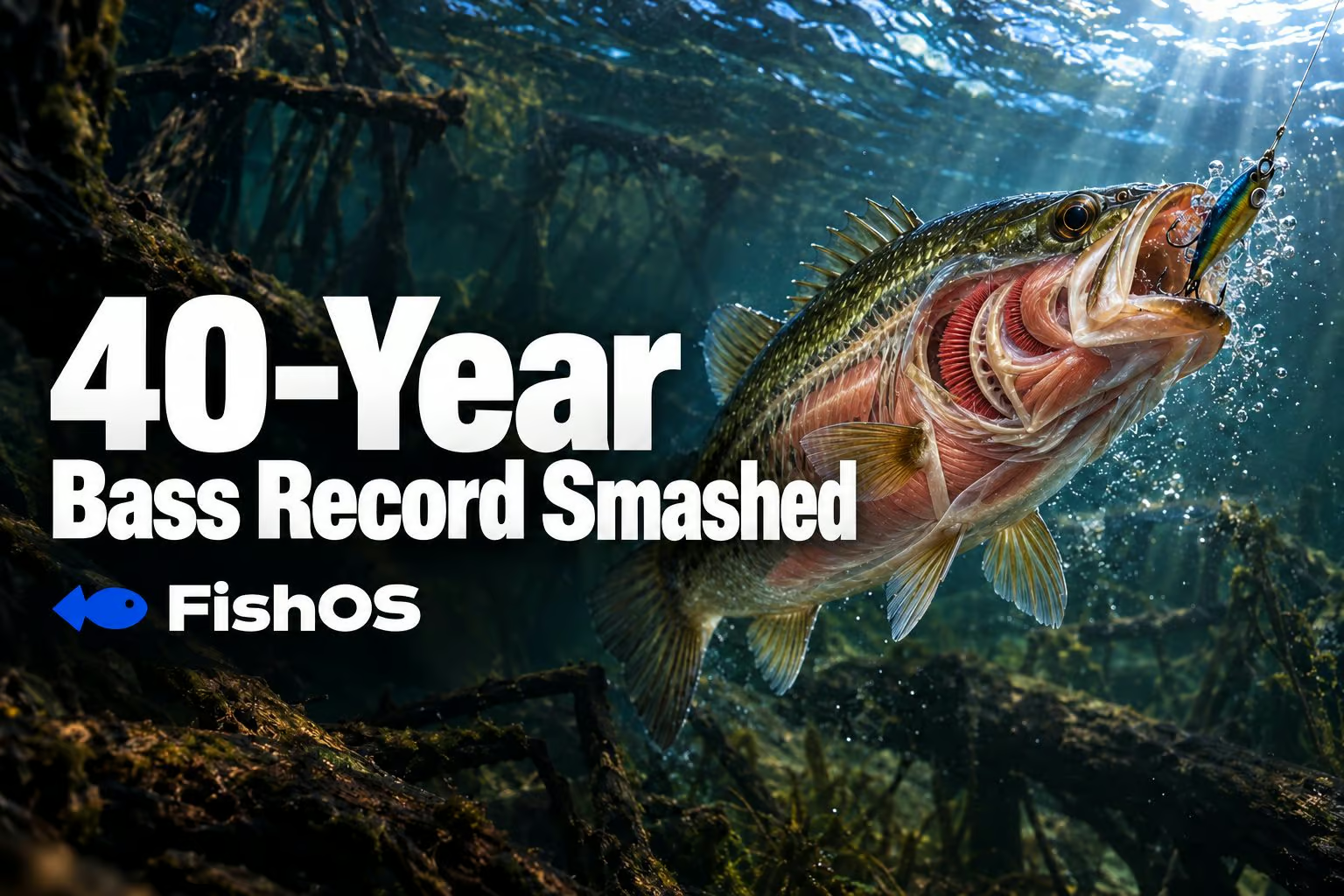
Joe Durden and Wynn Fletcher caught it during the Fifth Annual Liberty County Bulldog Booster Bass Tournament on the Apalachicola River.
Durden initially thought the fish was a catfish because it fought deep and hard. It surfaced beside the boat, showed itself to be a bass, and Fletcher netted it after it moved around the boat.
How the fish was caught
Durden found the fish while working a backwater slough outside the river’s main current. He said four or five good fish were holding there. The mouth of the slough was about 12 feet deep, but the bottom rose to 4 feet inside before dropping back to 8 feet, where the fish he had marked on sonar were holding.
He said the fish fought deep and hard, and that he initially believed it was a catfish. Once it came near the boat and surfaced, he recognized it as a bass. The fish then darted around the boat before Fletcher netted it and put it in Durden’s Skeeter boat.
Durden weighed the bass in his boat at 3 pounds 14 ounces. He contacted a friend, learned that the existing state record was smaller, and then took the fish to certified scales. A state biologist examined it to confirm that it was a spotted bass and that it qualified as a record.
Official record and verification
Strickland confirmed the final weight of 3.93 pounds and length of 18.25 inches.
Strickland said catching a state record fish is a tremendous accomplishment for any angler, particularly a record that has stood the test of time for 40 years.
What this catch suggests for anglers
The record fish came from a slough with a distinct bottom transition, not from open water or the main river current. Durden marked fish on sonar before casting. For other anglers, the useful detail is the layout of that holding zone: shallow bottom inside the slough, then a drop into deeper water where four or five fish were grouped.
Durden expected a catfish based on the fight, while the fish was a spotted bass. Its size was enough for him to check the state record immediately after landing it.
Spotted bass are not limited to one river system or a narrow range. The U.S. Geological Survey’s Nonindigenous Aquatic Species database identifies the spotted bass, Micropterus punctulatus, as native to the Mississippi River basin from southern Ohio and West Virginia to southeastern Kansas and south to the Gulf. Its native range also includes Gulf Slope drainages from the Chattahoochee River in Georgia to the Guadalupe River in Texas. The same database lists Florida observations dating from 1941 to 1980 across the Apalachicola, Lower Chattahoochee and Lower Flint drainages.
If you catch a possible record fish
Durden’s sequence shows the basic order of work. Other anglers should follow the applicable Florida Wildlife Conservation Commission process for any fish that may exceed a state record, including documentation, certified-scale weighing and species confirmation. The steps below cover the parts of that process shown in this catch.
- Photograph the fish and keep the catch details, including the lure, depth and GPS position, before release.
- Use the applicable certification process for a possible record catch, including certified-scale weighing and species confirmation.
- Retain the fish long enough for a state biologist to confirm its species and official measurements.
- Contact the Florida Wildlife Conservation Commission for the current record-fish application and verification requirements before releasing a possible record catch.
What to do now
- Use sonar to inspect changing structure in backwater sloughs, especially where the bottom rises and then drops into deeper water.
- Weigh and document any unusually large fish before release.
- Contact the Florida Wildlife Conservation Commission about certified scales, biologist verification and the state-record application if a fish may exceed the record.
- Record the lure, depth and GPS position while the fish and catch location are still fresh.
Durden said they did not do well in the tournament that day, but that catching a state-record fish is better than a win anyway. He plans to have the bass mounted by a taxidermist.
FAQ
What did the Florida state-record spotted bass weigh?
The fish weighed 3.93 pounds and measured 18.25 inches long.
Where was the Florida state-record spotted bass caught?
Joe Durden and Wynn Fletcher caught it during the Fifth Annual Liberty County Bulldog Booster Bass Tournament on the Apalachicola River.
How long did the previous spotted bass record stand?
The record Durden broke had stood for 40 years.
Related coverage
- The South’s Hot Winter Bass Fishing Really Starts Brewing in Fall
- The Stories Behind Some of Bass Fishing’s Greatest Baits