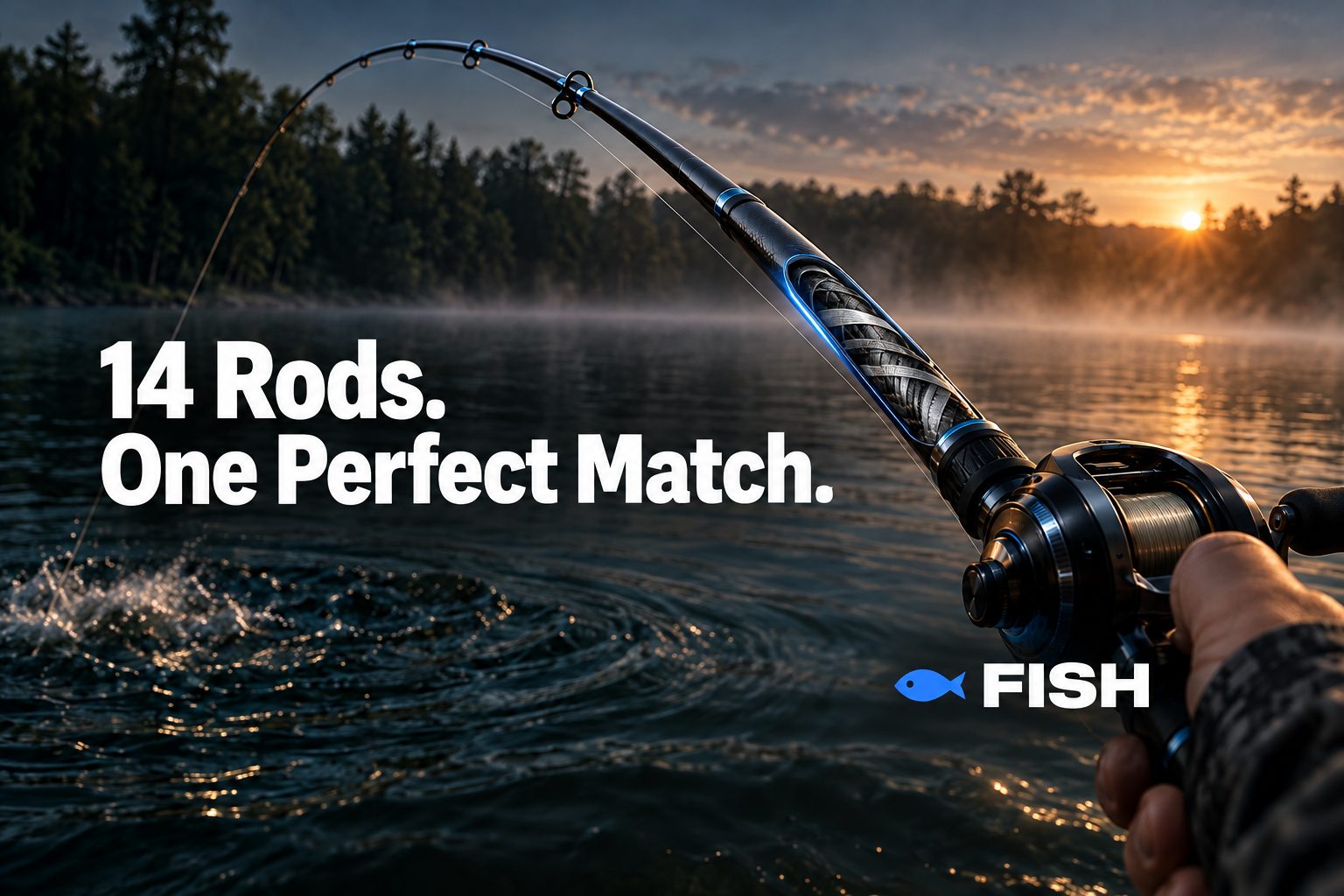
A bass rod earns its place on a deck through the quality of its blank, guides, reel seat, and handle rather than its price tag. The current market gives anglers a wide spread of designs tuned to specific techniques, from flipping sticks and chatterbait rods to finesse spinning models and big-swimbait heavyweights. The picks below group rods by the job they do best, with the construction details that set each one apart.
What Actually Separates a Good Bass Rod From a Great One
A rod blank’s graphite or carbon composite controls two things an angler feels on every cast: sensitivity at the tip and power in the lower half. Multi-graphite layups like Lew’s LFS-X3 blend aim to balance lightweight handling with backbone, while higher-modulus 30-ton and 36-ton carbon blanks, used by Okuma and 13 Fishing respectively, push sensitivity higher. Component choices matter just as much. Fuji Concept O and K-Series frames with aluminum-oxide, alconite, or FazLite inserts decide how cleanly braid or fluoro leaves the rod, and a tapered split-grip handle decides how long an angler can fish without forearm fatigue.
Length, power, and action set the rod’s job
A 7-foot medium-heavy fast-action casting rod covers the widest range of lure weights for most techniques in open water. Rods around 6-foot-10 punch through cover better, rods past 7-foot-4 generate longer casts and give anglers the mechanical advantage to drive hooksets through thick grass. Fast tips detect subtle bites on wacky rigs and shaky heads, moderate tips keep spinnerbaits and chatterbaits tracking true, and a moderate-fast tip, like the 7-foot-4 model described above, covers the middle ground.
All-Purpose Casting Workhorse
The Lew’s LFS Series sits at the top of the all-purpose list because the LFS-X3 graphite blank handles a wide range of lure weights, from quarter-ounce moving baits up to heavier Texas rigs and topwaters. The Fuji Concept O guides with polished aluminum-oxide inserts manage heavy braid without friction loss, and the exposed blank section against the angler’s hand plus a split-grip cork handle keep the rod light through a full day. A 7-foot, 4-inch medium-heavy moderate-fast model works as a single rod for anglers who want to cover many techniques without a quiver of sticks.
Flipping, Pitching and Punching Power
The Daiwa Proteus, originally an inshore saltwater rod built for yellowtail and calico bass, brings serious backbone to flipping and punching thanks to its High Volume Fiber (HVF) carbon blank and X45 Bias construction that prevents the rod from twisting under heavy loads. Its 7-foot, 6-inch medium-heavy model drives thick-wire hooks through green jaw and pulls fish out from under matted vegetation with heavy tungsten weights. The Fuji K-Series tangle-free guides and 65-pound braid rating give it the capacity to swing jigs and soft plastics into tight cover.
Spinnerbait and Chatterbait Sensitivity
The Shimano Zodias B pairs a hollow full-carbon monocoque rear grip with Shimano’s Hi-Power X carbon tape wrapping, which amplifies blade thump straight into the angler’s hand so a bass inhaling the lure reads differently than grass fouling the hook. The 6-foot, 10-inch medium-heavy moderate-action model, rated for 3/8- to 1-ounce baits, is the unconventional pick here, while longer 7-foot-1 to 7-foot-5 options cover anglers who want traditional length. The CI4+ carbon-polymer reel seat keeps weight down on a rod that gets cast all day.
Jig and Worm Finesse
The Okuma Tournament Concept B Series uses 30-ton carbon blanks with Fuji K-Concept frames and Fuji FazLite inserts to manage braid smoothly at low line weights. A 7-foot medium-heavy moderate-action model handles shaky heads, Texas rigs, wacky rigs, and light jigs on as little as 15-pound braid. The TPE split grips stay tacky when wet, and the lineup spans 15 technique-specific models including a 7-foot-6 medium-light spinning rod built for forward-facing sonar work.
Big Swimbait and Glide Bait Work
The Abu Garcia Beast is built specifically to throw massive swimbaits, glide baits, and umbrella rigs, with a 30-ton graphite blank reinforced by a Powerlux 200 resin system and a carbon-wrapped butt section for backbone. The two-piece 7-foot, 9-inch heavy moderate-fast model breaks down for transport while still driving hooks through the jaw of a giant fish. The two-piece ferrule locking mechanism keeps the blanks aligned under load so that the rod feels like a one-piece under heavy drag.
Budget-Friendly Baitcasting Entry Point
The 13 Fishing Oath Series delivers tournament-grade blank construction at a retail price well under $100. The Japanese PVG 36-ton carbon blank with proprietary cross carbon overlay, paired with tangle-free stainless steel guides with Alconite inserts and split-grip cork handles, gives new baitcast anglers a setup that lets mistakes be the operator’s fault rather than the gear’s. Models range from 6-foot-8 to 7-foot-11 with medium to heavy powers and fast to extra-fast actions.
BFS (Bait finesse) and Light-Line Rods
The FishUSA Flagship BFS Casting Rod is a purpose-built finesse casting rod sized for small Ned rigs, tiny crankbaits, and light-line applications where a standard baitcaster feels heavy. Paired with a BFS reel such as the Ark Gravity, 8-pound braid, and fluorocarbon leaders from 4- to 8-pound test, the rod has proven capable of handling surprisingly large fish across rivers, lakes, and ponds while still functioning as an ultralight baitcasting tool. G. Loomis IMX-PRO Bass covers the spinning side for anglers who want flagship sensitivity in a dedicated spin rod.
Specialty Techniques
Technique-tuned rods dominate the rest of the category:
- Topwater and frog: the Megabass Orochi X10 brings the tip action needed to work walking baits and mats of vegetation.
- Crankbait: the Trika Crankbait Series builds in the parabolic bend that keeps trebles hooked when a bass turns its head.
- Price-to-performance: the Ark Invoker Tour Series targets anglers who want premium blank quality without flagship pricing.
- Crossover spinning: the Fenwick rod works for both freshwater and light saltwater.
- Finesse spinning: the Quantum Myth Spin covers drop-shot and shaky-head techniques where tip sensitivity drives bite detection.
- Bass fly: the St. Croix Tannic Bass Series outfits bass-specific fly fishing in a dedicated rod weight.
How to Choose the Right Rod for the Way You Fish
Match the rod to the dominant lure and technique rather than chasing one do-it-all model. Start with the lure weight you throw most often, pick the power and action that handle that weight, then verify the blank material and guides match the line type you prefer. Anglers who spend their day on chatterbaits and spinnerbaits benefit from a moderate-action rod with a sensitive grip; anglers throwing big swimbaits want heavy power and a carbon-wrapped butt; anglers working finesse techniques want a fast tip with light braid. A two- or three-rod cover-the-water setup typically outperforms a single rod stretched across every technique.
FAQ
What makes one bass rod perform better than another?
Blank material and construction drive sensitivity and power, from multi-graphite blends like Lew’s LFS-X3 to 30-ton and 36-ton carbon blanks. Guides, reel seats, and handle construction control durability and how cleanly a rod loads on the cast and transmits bites.
Do more expensive bass rods always fish better?
No. A well-designed $100 rod like the 13 Fishing Oath Series can outperform a premium model when the higher-priced rod does not bring enough blank or component quality for the cost. Match the rod’s length, power, and action to the lure and technique instead of buying on price.
Should bass anglers pick spinning or casting rods?
It depends on the lure and technique, not preference alone. Baitcasters handle heavier line and cover techniques such as flipping, punching, and swimbait fishing. Spinning rods work better for finesse, light lures, and presentations like the wacky rig, drop-shot, and Ned rig.
This article summarizes reporting from wired2fish.com.