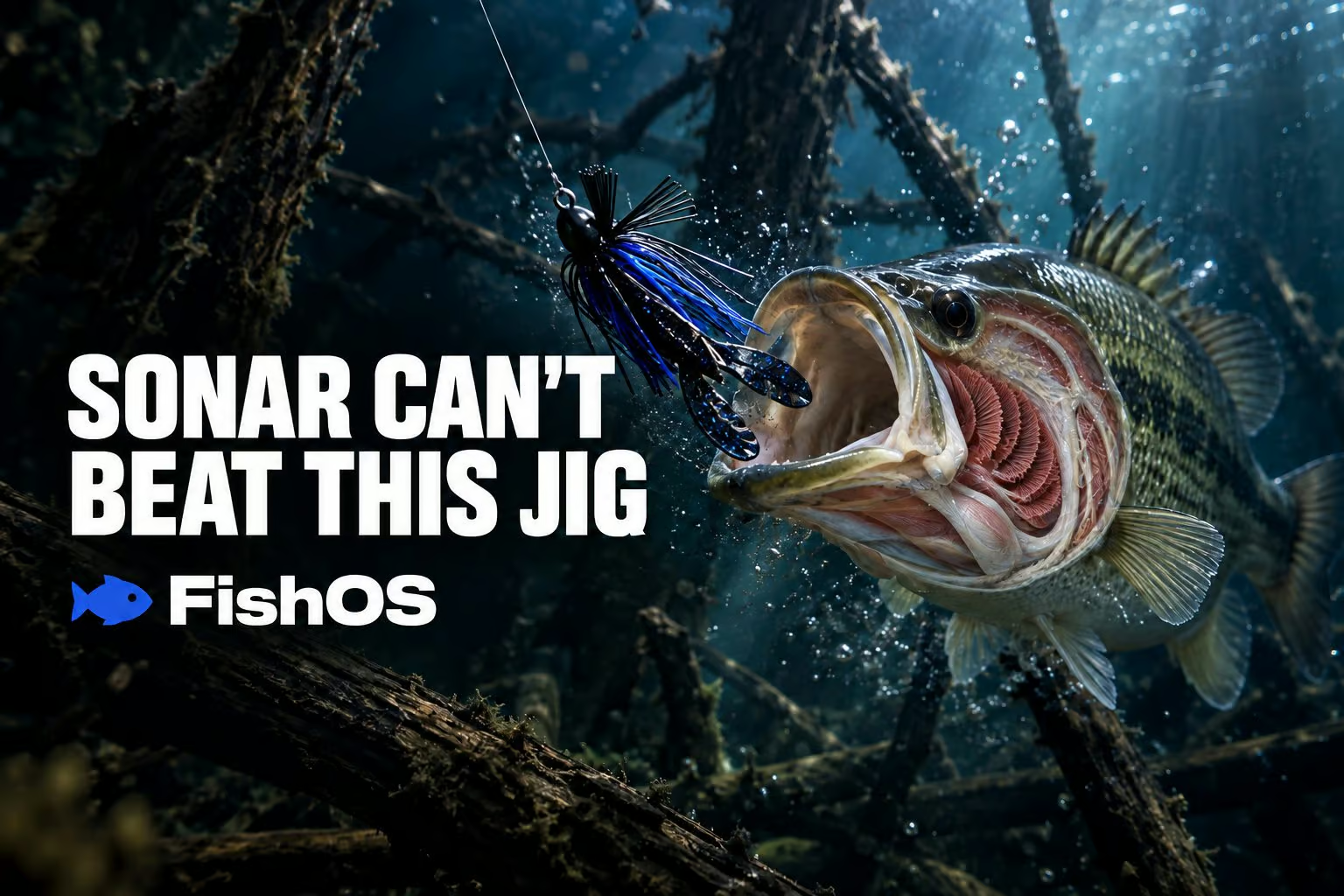
The jig still gives bass anglers a proven option for working heavy cover, isolated shallow structure and hard bottom, even as forward-facing sonar and newer baits change where many anglers look for fish. Greg Hackney, a professional bass angler, says the jig continues to catch larger-than-average fish because it can be worked through cover, adjusted for different conditions and used in several ways.
Forward-facing sonar systems such as Garmin LiveScope have opened access to suspended and open-water fish. That change, according to Hackney, did not empty cover and structure of bass. He has fished with jigs for 30 years and sees no reason to abandon a bait that remains effective in places where an angler needs to put a lure inside the cover.
Why a Jig Still Works
Before forward-facing sonar, anglers commonly targeted bass around laydowns, ledges and other structure because those areas were easier to find. Suspended fish were often left alone unless a topwater lure brought them up or an angler positioned the boat directly over them.
Forward-facing sonar broadened anglers’ access to suspended fish. Hackney said the change in fish location did not stop the bite on traditional cover presentations. His view is that anglers often focus on new equipment when it first becomes popular, while established techniques remain available throughout the year.
The jig gives an angler a way to present a lure inside the cover. Hackney identified bushes, grass, lily pads and other tight cover as places where he wants to work a jig thoroughly rather than make a single pass.
How Sonar Changed Jig Fishing
Hackney said he has seen many everyday anglers focusing on their screen and an overall decrease in pressure around cover on tour. In a couple of tournaments, he said, an angler who wanted a fish like that had it all to himself and could run late in an event and still have that cover to himself.
That change affects the number of fish an angler must divide with others. Cover-oriented bass may be spread out and can be larger than average. If seven fish bite across a group during a day, dividing those opportunities among two or three anglers can make it harder to assemble a competitive catch.
The pressure does not make each jig-fished fish easier to catch one on one. It gives a jig specialist more cover to work without sharing every target with the same number of anglers. Hackney also said that the apparent lack of competition on tour has not changed his approach: the jig still catches bigger-than-average fish for him.
Why the Jig Is Efficient
Hackney prefers a jig in some conditions where modern techniques also work, including fishing an urchin. He described a shallow stretch where fish would bite a Coike or a swim jig. In his experience, fishing the Coike takes more time, while a swim jig allows him to cover more water.
He estimates that a swim jig catches 99 percent of the fish that bite it. He still regards the Coike as a good target bait when covering water is not the priority. The comparison is Hackney’s experience rather than an independent performance test.
Adjustments expand the available choices. A jig’s size, weight, skirt material, skirt thickness and trailer can each change how it behaves. This may allow you to effectively dial in a jig for various cover situations.
Three Cases for Fishing a Jig
Flipping Heavy Cover
Hackney favors a jig for cover that needs a thorough presentation, including bushes, lily pads and grass. He places his hookup ratio for flipping a jig at about 95 percent and said he could not make the same claim for a Texas rig.
That experience supports his preference for a jig when an angler needs to work tight cover carefully. His comparison concerns his own fishing and does not establish a universal hookup rate for either technique.
Swimming It Over Isolated Shallow Cover
Hackney uses a swim jig over isolated cover in extremely shallow water. He says he can cast it 60 yards and keep it in the strike zone for 60 yards. He also fishes it faster than a bladed jig or spinnerbait and can match different types of forage.
New Jersey’s Department of Environmental Protection likewise includes jigs among effective bass lures as water temperatures rise. Its largemouth bass fishing guidance states that jigs and spinnerbaits can be extremely effective at about 50 degrees, and it also lists jigs among effective choices in mid-to-late spring.
Dragging It Over Hard Bottom
Forward-facing sonar can leave some fish near the bottom outside the angler’s view. Hackney describes a dead zone of roughly 12 to 18 inches above hard bottom, particularly in current, where bass can remain hidden.
He described a common sequence on the water. An angler might catch one fish and then see others nearby, or pull up a fish that had been concealed. The near-bottom area can still provide a target for a jig dragged along hard bottom.
What to Do Now
- Keep a jig ready for cover that requires a thorough presentation.
- Match the jig’s size, weight, skirt material, skirt thickness and trailer to the available cover and forage.
- Use a swim jig when covering a shallow stretch around isolated structure.
- Check the area close to hard bottom, especially in current.
- Choose flipping, swimming or dragging according to the structure and water conditions.
FAQ
Why Do Bass Anglers Still Use Jigs?
Hackney says bass still relate to cover and structure. He also describes the jig as efficient, adjustable and useful for presenting a lure inside places where fish may hide.
Has Forward-Facing Sonar Made Jigs Obsolete?
Hackney says forward-facing sonar has given anglers more access to suspended and open-water fish without removing bass from cover and structure, where he continues to fish with jigs.
When Is a Jig Preferable to Other Lures?
Hackney recommends a jig for flipping heavy cover, swimming over isolated cover in extremely shallow water and dragging along hard bottom where fish may remain within roughly 12 to 18 inches of the bottom.