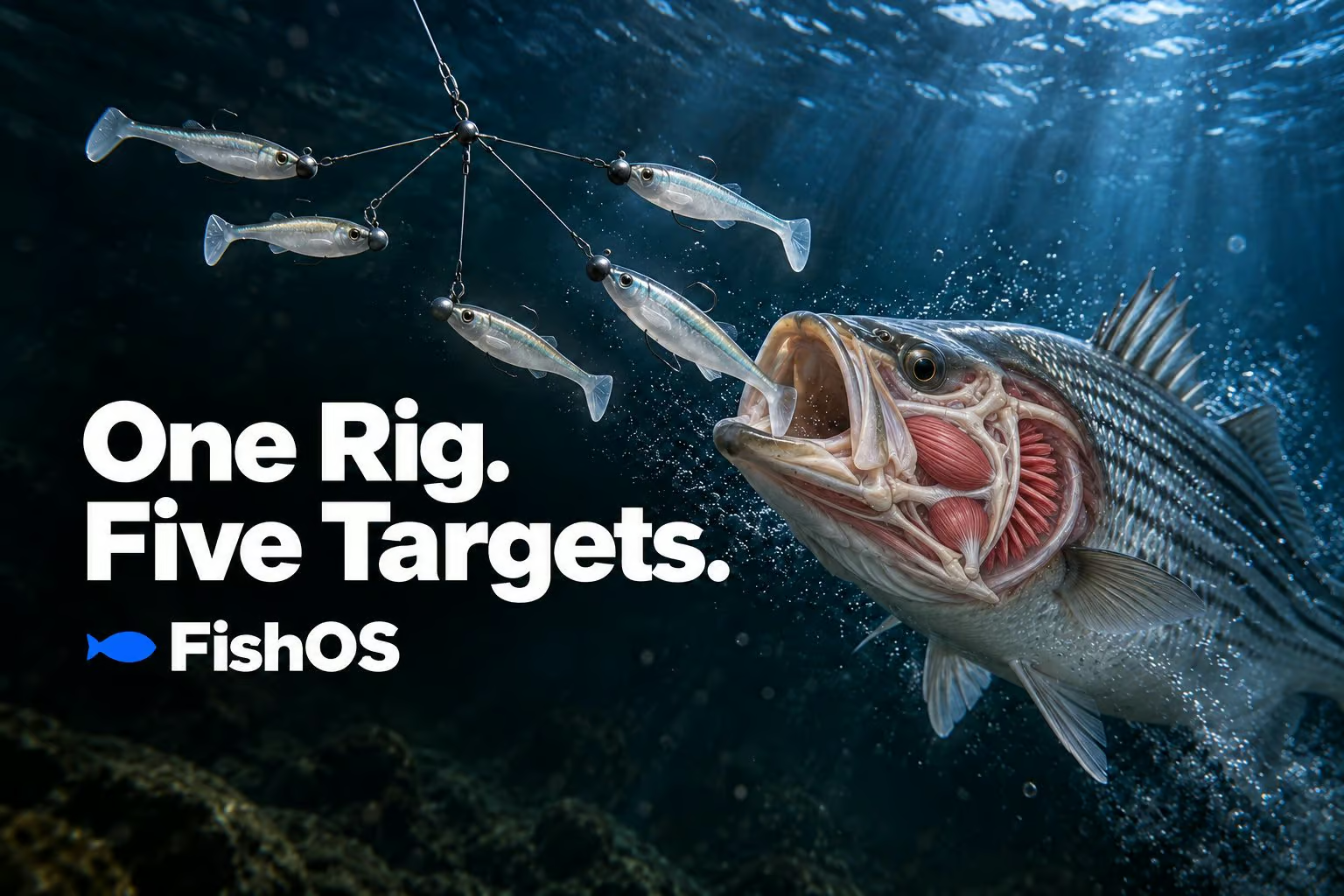
An umbrella rig lets a striper angler show the fish a whole pod of baitfish on one line and search more water on every pass.
How do you run an umbrella rig for stripers?
Anglers troll it behind a moving boat, including for stripers in cold water. That put nine hooked baits on each rod, a fair imitation of a small school swimming together. When a rod loaded up, the guide knocked the boat out of gear and reeled in the other rig while the angler fought the first, landing two fish of 8 to 9 pounds each on one rig.
What is an umbrella rig?
The hardware is an umbrella-shaped frame of multiple wires with lures or baited hooks hung off the arms. The Indiana Department of Natural Resources describes the frame as designed to resemble a school of baitfish, which is the whole point: stripers feed and travel in schools and chase long, narrow forage such as sand lance, alewives and menhaden, according to the Massachusetts Division of Marine Fisheries. A spread of baits reads as that school, and a slightly off trailer can appear to be a sick or injured fish in the school.
How the baits are rigged
Rigs run from small castable arms to arms two feet long or more, and they can carry soft-plastic shads, spoons or tubes. The traditional saltwater version uses tubes made from dyed surgical tubing, armed with bent hooks or wire that make them spin when pulled. Short tubes with a sharp bend spin faster and are preferred for bluefish and weakfish, while longer tubes with a gentle curve give the lazier action that stripers and big blues go for. A standard umbrella rig can also be fished with a drail, with swim shads swapped for tubes and sand eel imitations when sand eels are the main bait in the water.
When do stripers hit an umbrella rig?
That Lake Hartwell guide finds the rig at its best once water temperatures drop to the low to mid-50s, when stripers turn dormant and will not chase a bait but will swipe at a rig passing by. He describes it as an impulse bite: the fish are in a neutral or even negative mood, the big rig comes screaming through, and their first instinct is to kill it. The rig also suits catch-and-release anglers, because stripers tend to get hooked inside the mouth or on the outer jaw rather than deep.
Getting the spread to the right depth
Weight and line get the rig down to fish holding deep. Wire-line setups use a stout boat rod and a reel loaded with 150 to 300 feet of stainless or Monel trolling wire, usually 40-pound test. At trolling speeds of two to four knots, one rule of thumb is about one foot of depth for every ten feet of wire out, so 200 feet of wire puts the rig near 20 feet. Fishing umbrellas on downriggers provides fast and easy depth control and allows for the use of monofilament line.
On-water safety and tackle guidance
That maker recommends at least 50-pound test with its umbrella rig and a 10-yard leader rated 130 pounds or more in case the rig snags. The company says its rigs are built with 100-pound mono and terminal tackle, so the mono or terminal tackle usually breaks first and you recover the rig. For trolling, it advises lowering the rig in and paying line out slowly to at least 30 yards behind the boat, holding a slow troll around 3.5 knots, trolling with the current for added depth, and not deploying the rig in less than 15 feet of water. When a fish hits, the company says to keep the boat in gear unless both rigs are hooked up, then work the rod with short pumps while reeling and jigging, which it says may produce more than one fish. Treat the 50-pound, 130-pound, 3.5-knot and 15-foot figures as that maker’s claims for its own rigs and adjust to your tackle and water.
Is your umbrella rig legal where you fish?
It is worth checking the rules before you tie one on. Confirm three things with your own state fish and wildlife agency before you tie one on: whether umbrella or multi-bait rigs are permitted at all in your water, how many hooks or baits a single rod or line may carry, and whether any arms must be unhooked teasers. Limits differ from one place to another. In Maryland tidal water, under the General Assembly’s Natural Resources Article, a tidal fish licensee is limited to 2 hooks or 2 sets of hooks for each rod or line, though an artificial lure with multiple or gang hooks counts as one set, with exceptions for a finfish trotline and Atlantic Ocean state waters (Maryland General Assembly). Indiana’s existing rules did not adequately describe whether umbrella rigs were legal, so in 2012 DNR director Robert E. Carter Jr. signed a temporary rule allowing one rig or lure array for use with multiple artificial baits and no more than five hooks, according to the Indiana DNR. That rule did not cover certain Lake Michigan trout and salmon tributaries, where tighter single-hook limits stayed in force. The push came after professional bass fisherman Paul Elias won an FLW Series tournament with a version of the rig, a 20-fish limit weighing more than 100 pounds, the DNR said, while the rival BASS tour barred umbrella rigs from the Bassmaster Classic and Elite Series.
What to do now
- Check the rig before it goes in: inspect the frame, arms, hooks and leader connections, and confirm each baited point is secure.
- Match the method to the water: bottom fishing for a stationary placement, vertical for an upright spread, drifting with the current, casting from the boat, or trolling behind it at a slow, controlled speed.
- Set your depth deliberately: use weight, wire or lead-core line and count your line out, since depth tracks roughly with how much line is in the water.
- Confirm the hook rules: ask your state agency how many hooks or baits one rod or line may carry on a multi-bait rig in the water you plan to fish.
FAQ
What is an umbrella rig used for?
It is a trolling and multi-bait setup for stripers and similar fish, built on an umbrella-shaped wire frame that carries several lures so the spread imitates a small school of baitfish, according to the Indiana DNR.
When do umbrella rigs work best for stripers?
One Lake Hartwell guide finds the bite is best once water temperatures fall to the low to mid-50s, when stripers turn dormant and strike the passing rig on impulse rather than chasing a single bait.
How many hooks can an umbrella rig have?
It depends on where you fish. Maryland limits a tidal fish licensee to two hooks or two sets of hooks per rod or line, while Indiana’s 2012 temporary rule allowed a lure array with up to five hooks. Check your own state agency before fishing.