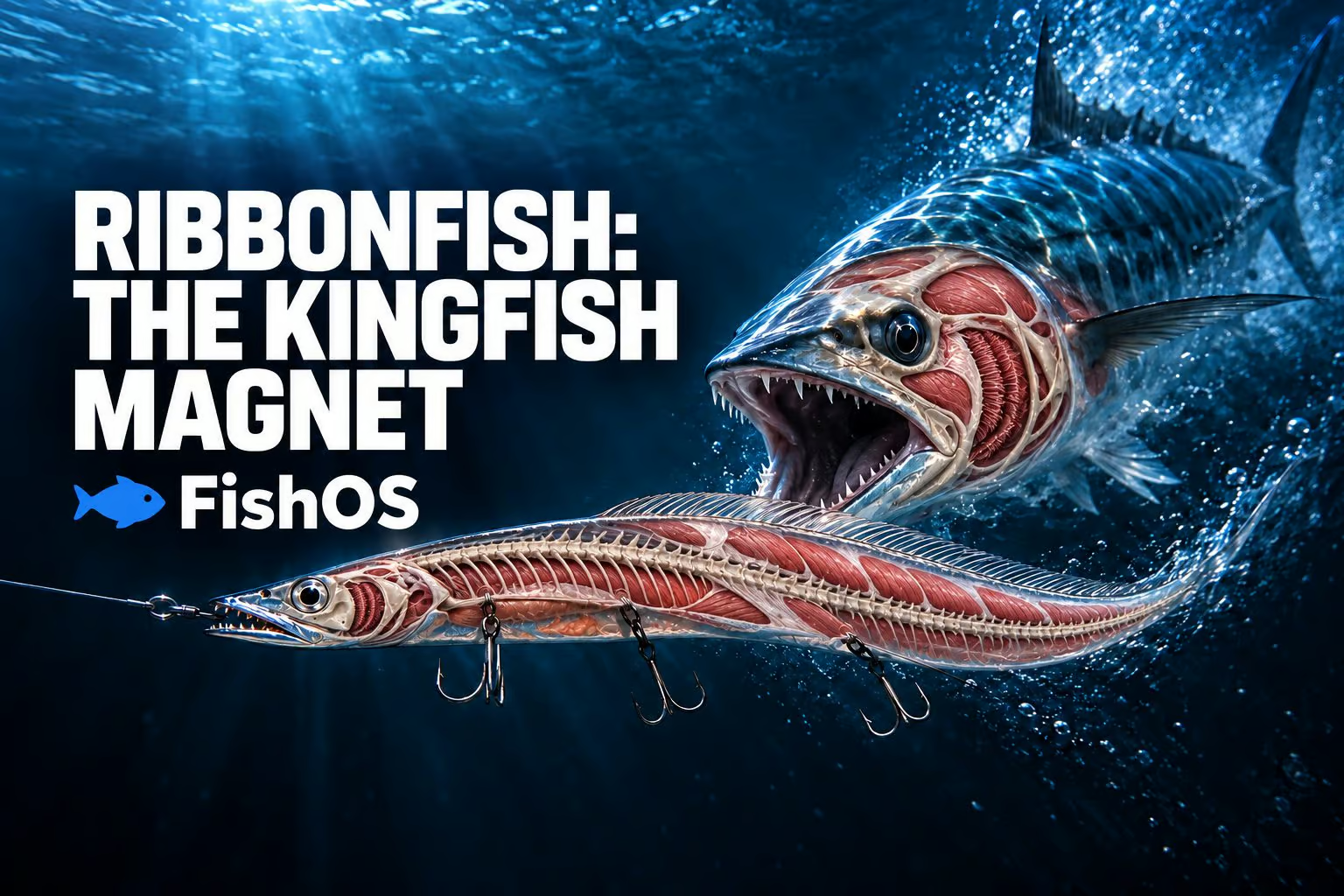
Ribbonfish give king mackerel anglers a strong alternative to smaller live baits because their reflective sides, long profile and ability to carry several hooks can improve the way a trolling spread is presented. Catching them one at a time, brining them promptly and rigging them on wire stinger hardware helps preserve their color, body shape and swimming action. These Atlantic cutlassfish, often called ribbonfish, are silver forage fish with a ribbony dorsal fin, a thin tail and sharp teeth.
Bait-quality ribbonfish generally measure 18 to 24 inches, although tournament anglers also look for clear-eyed fish measuring 22 to 26 inches when buying frozen baits.
Why ribbonfish work for king mackerel
Mark Henderson, a tournament angler discussing ribbonfish, said they can become abundant during a run and appear in large numbers like a mullet run. Their reflective sides remain visible underwater, and a 22- to 26-inch ribbonfish adds a distinct movement to a spread of smaller baits.
Henderson also said that multiple hooks give an angler more opportunities to hook a fish. He recommended starting with a mixed spread when a ribbonfish run is present, since the fish may be targeting the available bait. In one Florida outing on a ledge, bites occurred on ribbonfish while goggle eyes, blue runners and speedos were also in the spread.
How do you catch ribbonfish for bait?
Nighttime hook-and-line fishing gives anglers the chance to select ribbonfish individually. Hand-caught baits are preferred over fish taken in a cast net because net-caught ribbonfish can be scarred and less shiny. Catching fewer fish in good condition is more useful than bringing in a large number of damaged baits.
A common method is to anchor near a port and place a green light below the boat. Ribbonfish may gather around the light, especially during warmer months when they enter deeper ports in numbers. If the fish are scattered, shiny lipless baits or diving plugs can cover water to locate them. When ribbonfish are concentrated, cut bait on a long-shank hook can work. Glass minnow, cut mullet and dead ribbonfish are suitable pieces. Live or firm food-quality shrimp may also produce a strike; soft frozen shrimp may perform less well.
What gear works for catching ribbonfish?
Medium-heavy spinning tackle can handle ribbonfish and the strong bites that may occur around a light. One setup uses cut mullet on a size 2 or 4 hook with a small light stick about 18 inches up the leader. Split shots can add weight if wind or strong tidal movement pulls the bait away from its position.
One Florida angler said cutting a full-length light band in half makes it easier to thread the leader through the light. A long-handle dehooker helps protect the bait and keeps fingers away from the teeth.
Use extra care because a hooked ribbonfish can wrap around a forearm. Its rough underside can scrape skin, particularly when the fish is moving and the angler is trying to control it. Keep the light stick, dehooker and terminal tackle within reach before fishing around a concentrated school.
How do you prepare ribbonfish for later use?
Because ribbonfish fishing often takes place at night, bait that will be used the next day can lose color and become fragile. The source article recommends immediate brining with coarse kosher salt and baking soda mixed at a three-to-one ratio, combined with two gallons of seawater and ice in a cooler.
A five-gallon bucket containing the same dry ingredients and seawater can receive ribbonfish during the initial dehooking process before they are moved to the brining cooler. Entrails can be removed when time allows.
Freeze each ribbonfish flat and separately. Vacuum sealing can help preserve it, but the teeth may puncture a bag. Wrapping a paper towel around the teeth reduces that risk. Store the baits in an insulated ribbonfish bag until fishing.
When buying frozen ribbonfish, Doug Watters said that bigger is not always better. He looks for a clear-eyed fish measuring 22 to 26 inches that appears fresh. Direct freezing can produce a soft, mushy bait after thawing.
How do you rig ribbonfish for king mackerel?
A wire leader and stinger rig give the bait enough hardware for its length. Henderson’s setup begins with a 4/0 single hook through the nose, with a green, blue or pink duster skirt above it on the leader. The wire runs to a No. 2 or No. 4 4x-strong treble, followed by additional treble segments spaced about 3 to 4 inches apart.
Two points from each treble can be secured through the ribbonfish’s side. Leave a little slack between segments so the bait can move naturally. A tight rig can pinch the bait and distort its swimming action. Some anglers replace the lead hook with an upturned jig head set through the mouth to help the bait track straighter.
Silver paint can blend the wire into the bait’s reflective profile. Red paint can imitate the blood from a vulnerable bait. A hybrid live-and-dead presentation, known as a zombie rig, uses a treble hook and swivel to place a live bait behind a rigged dead ribbonfish. The live bait’s movement after being tailed can create the erratic action that attracts king mackerel.
Related king mackerel terminal rigs provide another way to build a larger bait profile. One double-pogy rig uses 58-pound-test wire, 38-pound-test wire, extra-strong trebles, swivels and haywire twists. The system can also work with ribbonfish and other baitfish.
Where can ribbonfish be placed in a trolling spread?
Doug Watters said he places ribbonfish on downriggers with one above and one below the thermocline, generally about 10 to 20 feet apart. This separates the baits vertically and gives the spread a different depth range. A ribbonfish can also be placed toward the back of the spread, where its swimming action may distinguish it from smaller baits.
Another approach uses two downriggers to cover the upper two-thirds of the water column. One example places one silver eel at 10 feet and another at 20 feet in 30 feet of water, with about 20 feet between each bait and its downrigger weight. Another option is running rigged eels on surface flat lines at about 30 and 40 feet behind the boat and trolling the spread at up to 3.5 knots.
For larger kingfish, serious crews prepare boats for downrigger trolling, kite fishing, slow trolling, drifting and anchoring. Carrying electronics for finding structure and bait is also recommended, along with the terminal tackle needed to adjust to different feeding patterns.
What to do now
- Gather medium-heavy spinning tackle, a size 2 or 4 hook, cut mullet, a small light stick and split shots before heading to a port where ribbonfish are running.
- Anchor near the port and place a green light below the boat. Use shiny lipless baits or diving plugs if the ribbonfish are scattered.
- Keep a long-handle dehooker nearby and avoid allowing hooked ribbonfish to wrap around your forearm.
- Brine fresh ribbonfish promptly, freeze each fish flat and individually, and protect the teeth with paper towel before vacuum sealing.
- Rig the bait on a wire leader with a nose hook and spaced treble segments, leaving slack so it swims naturally.
FAQ
How do you catch ribbonfish for bait?
Anglers often catch ribbonfish at night by anchoring near a port and placing a green light below the boat. Shiny lipless baits and diving plugs work when the ribbonfish are scattered, while cut bait can be effective when they gather in confined areas.
How should ribbonfish be prepared and rigged?
Fresh ribbonfish can be brined with a three-to-one mixture of coarse kosher salt and baking soda combined with seawater and ice. Freeze them flat and individually, then rig them on a wire leader with a nose hook, treble hooks and spaced stinger segments.