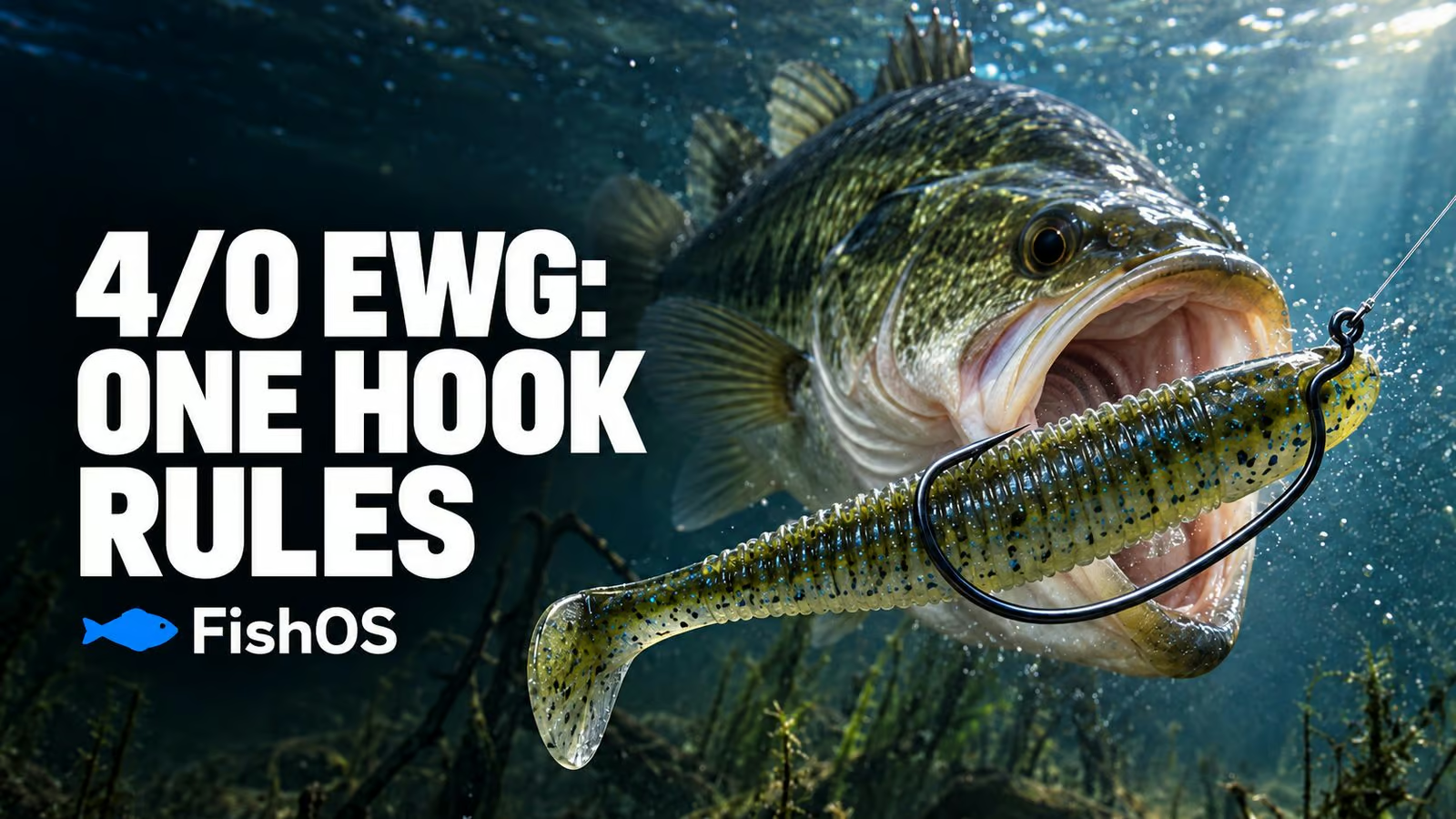
In one angler’s opinion, a single 4/0 EWG can cover the majority of the single-hook soft plastic presentations you fish for bass. That view holds that the Gamakatsu extra-wide gap hook, and the 4/0 size in particular, is the most versatile single hook for bass, usable for flipping tubes, dragging worms, rigging weightless flukes, and buzzing toads across the surface. What follows is what the design does, what manufacturer and independent sizing guidance says, and how anglers rig it.
What is an extra-wide gap hook?
The EWG is named for the extra-wide gap between the point and the shank. That gap is why it suits weedless soft plastic rigging: when you thread a thicker bait on, the excess material gathers in the bend without filling the gap and blocking the hookset. On a straight shank or an offset round-bend hook, that same bulk can crowd the point and cost you fish. That gap is the main reason the hook works across so many rigs.
The choice can be framed simply: use EWG hooks for bulky soft plastics such as creature baits, craws, tubes, and bulky worms, and use offset worm hooks for slimmer worms and finesse presentations. The wide gap is designed to give the point more clearance to swing and find flesh on the hookset, and the longer shank on many EWG designs can help keep bulky baits weedless and stop the plastic from sliding down the hook.
The gap advantage is not absolute in every dimension. One 2014 comparison of two 4/0 hooks found the standard offset model actually had more distance between the point and the offset bend, 3 centimeters versus 2.2 for the EWG, and more height between the point and the line of pull, more than 1.5 centimeters versus about 0.5 for the EWG. The angler who measured them came to believe that extra distance gives the point of an offset hook more room to break free of a slow-fished plastic once a bass engulfs the whole bait. The practical takeaway: EWG is the bulk specialist, not the only answer for slow, finesse worm fishing.
Beyond plain soft-plastic rigging, the EWG now shows up in the assembly of other terminal tackle and rigs, including the Tokyo rig and swing heads, and in some jigs, spinnerbaits, and buzzbaits.
Why the 4/0 size does the most
EWG hooks run from small to large. A size 1 is suited to rigging a dropshot weedless, and a 7/0 handles big swimbaits and giant worms. The 4/0 sits in the middle: big enough to wrangle a 10-pound fish yet small enough for a 10-ounce fish to take, and it carries a wide range of soft plastics, from 3.5-inch tubes to 8-inch ribbon-tail worms.
That range tracks with the broader sizing guidance anglers publish. The Tackle Flagship chart matches hook size to bait length as a starting point: roughly 1/0 for a 3-inch bait, 2/0 for 4 inches, 3/0 for 5 inches, 4/0 for 6 inches, and 5/0 for 7 inches and up, and it states that most soft plastic bass lures can be fished with hook sizes between 2/0 and 5/0. The same guide calls a 3/0 EWG one of the most versatile choices for a beginner. Match the hook to the lure before the fish, that source adds, because a two-pound bass can eat a bait rigged on a 4/0 while a larger fish can be landed on a smaller hook when the lure calls for it.
Manufacturer guidance lands in the same zone for a different style. Gamakatsu advises that hook size follows bait size, and gives a round-bend example: a 3/0 would be a good choice for fishing a 7-inch worm on a round bend style hook. The company adds that a 5/0 in the same style covers 10-inch worms. Read alongside the EWG sizing above, that is a useful reference point: style changes the exact number, so confirm the maker’s recommendation for the specific hook you are rigging rather than carrying one size for everything.
How anglers rig a 4/0 EWG
Toads
A hollow-body or soft toad such as a Zoom Horny Toad or a Ribbit pairs with a 4/0, often on a Gamakatsu SuperLine Offset EWG. That hook has a thicker shaft for added strength when pulling fish from lily pads and other vegetation. The writer adds a slight bend to the bait so the toad rides nose-up on the surface, and finds that easier to do with an EWG than with a screwlock toad hook.
Soft swimbaits
A 5-inch swimbait such as a Reaction Innovations Skinny Dipper or a Zoom Uni Toad fits the 4/0, with the point landing near the tail of the bait. The hook strength helps when a fish buries in grass. A bell weight can be added as a belly weight on this type of swimbait, and the wide gap accommodates that extra hardware without blocking the hookset.
Flukes and soft jerkbaits
Rigging a Zoom Super Fluke or a similar soft plastic jerkbait such as a Berkley Jerk Shad on a 4/0 EWG does two things: it improves the hookup ratio, and it adds casting weight to an otherwise light bait. A soft jerkbait is prone to balling up on the hook. The small increase in metal in the SuperLine version is noticeable, letting the bait cast a little farther and work a little faster.
Texas rig
A Texas rig works on a traditional offset round-bend hook, but the 4/0 EWG is a strong option for chunkier baits in and around sparser vegetation. Tubes and beavers can be too bulky for a standard round-bend hook, and switching to an EWG gives the point more bite without major downsides.
Where the EWG is not the pick
For punching heavy mats, a straight shank flipping hook slips more easily into thick cover and makes a thinner presentation. Treble-hook techniques are a separate matter. For single-hook soft plastic work in lighter to moderate cover, the EWG covers the majority of situations, and the 4/0 is the most versatile size within that style.
Clear water and smaller fish are the other limit. The homevison write-up notes that a 4/0 can be overkill in very clear water or for smaller bass, where the fish may take the bait more delicately, and that downsizing to a 2/0 or even a 1/0 EWG can start producing bites in those conditions.
What to do now
Confirm the maker’s recommendation for your exact hook before you rig it, since everything here is general guidance.
- Size the hook to the bait, not the fish. As a starting point, Tackle Flagship matches a 3-inch bait to about 1/0, a 5-inch bait to 3/0, and a 6-inch bait to 4/0, with most soft plastics covered between 2/0 and 5/0. Gamakatsu suggests a 3/0 for a 7-inch worm on a round-bend style, so expect the number to shift with hook style.
- Judge gap against bait thickness. Rig the bait weedless, then check that the plastic gathers in the bend and leaves the point enough clearance. If the bulk crowds the point, try a wider-gap hook or adjust the hook size until the plastic tucks into the bend and leaves the point clear.
- Use a thicker-shaft hook for grass. The Gamakatsu SuperLine Offset EWG has a thicker shaft that adds strength for pulling fish from lily pads and other vegetation.
- Downsize in clear water. If bass are short-striking in clear water or running small, dropping to a 2/0 or 1/0 EWG can turn those taps into hookups, per the homevison guidance.
- Switch styles for mats. When you are punching thick mats, change to a straight shank flipping hook rather than forcing the EWG into cover it was not built for.
FAQ
What sizes does the EWG hook come in for bass?
Sizes run from small to large: a size 1 for rigging a dropshot weedless, up to a 7/0 for big swimbaits and giant worms. In one angler’s view, the 4/0 is the most versatile size. Published sizing guides place most soft plastic work between 2/0 and 5/0.
What soft plastics work best on a 4/0 EWG?
The piece says the 4/0 carries baits from 3.5-inch tubes to 8-inch ribbon-tail worms, and names toads, 5-inch swimbaits, soft jerkbaits or flukes, and Texas-rigged tubes and beavers as good matches.
Is the EWG a good hook for punching mats?
No. The EWG is not ideal for punching. A straight shank flipping hook is the better choice for slipping into heavy mats, with the 4/0 EWG reserved for chunkier baits in and around sparser vegetation.